Revised 29 November 2026 for Eleven v4 and v4 Turbo. The first version, dated 18 June 2026, covered v3, Multilingual v2 and Flash only, and quoted Flash at about 75ms. Every price, language count and limit here was re-read from ElevenLabs' own docs and pricing pages on 29 November 2026. The latency figures are ElevenLabs' stated numbers: we have run no test calls and no listening test, so the quality calls are our editorial read.
ElevenLabs sells seven speech models, and two of them are where a new project should start. Use Eleven v4 for narration and video, and Eleven v4 Turbo for a live phone agent. ElevenLabs’ docs now call v3 and Multilingual v2 the previous generation, and Flash v2.5 costs the same as v4 Turbo through the API.
Paid link, we may earn a commission. How this works.
So that is the short answer. The rest of this page is the line-up, the price of each model, and the reasoning.
A quick plain-language note first. A voice model is the engine that turns your text into speech (text-to-speech, or TTS). ElevenLabs offers several at once. You pay in credits, a prepaid monthly balance that comes with your plan, or in dollars per 1,000 characters if you call the models from your own software through the API (the developer interface).
Seven models on sale, and two deprecated
ElevenLabs launched Eleven v4 and Eleven v4 Turbo on 28 September 2026, and its models documentation now leads with them. The line-up splits into two camps. Some models are made for speech you record once and play many times. Others are made to answer a person in real time, where a pause is the thing you are paying to avoid.
| Model | What ElevenLabs says it is for | Languages | Longest single request | Stated latency |
|---|---|---|---|---|
| Eleven v4 | Narration, audiobooks, dialogue | 90+ | 100,000 characters | none published |
| Eleven v4 Turbo | Real-time use and agents | 90+ | not listed | ~100ms |
| Eleven v3 (previous generation) | Expressive narration | 70+ | 5,000 characters | none published |
| Eleven v3 Conversational (previous generation) | Real-time use | 70+ | not listed | ~165ms |
| Multilingual v2 (previous generation) | Stable long-form narration | 29 | 10,000 characters | none published |
| Flash v2.5 | Real-time use and agents | 32 | 40,000 characters | ~100ms |
| Flash v2 | English-only real time | English only | 30,000 characters | ~135ms |
Every latency in that table is ElevenLabs’ own stated figure. We have not run a test call against any of these models.
Three lifecycle facts matter if you already build on ElevenLabs. Its docs describe v3, v3 Conversational and Multilingual v2 as the previous generation, with no retirement date for any of them. Turbo v2.5 and Turbo v2 are listed under “Deprecated models”, with Flash v2.5 and Flash v2 named as the replacements and, again, no removal date. ElevenLabs does print removal dates when it has set them (an older music model on the same page goes on 31 January 2027), so the absence of one for Turbo suggests nothing has been scheduled yet. And the new v4 Turbo is a separate model from the old Turbo line, despite the name.
One thing ElevenLabs’ pages disagree on is v4’s request size. The docs say 100,000 characters. The FAQ on its API pricing page says 10,000, and the main pricing page says a web app generation can run to 10,000 characters on v4 and 5,000 on other models. Plan around 10,000 until your own first long job proves otherwise.
What each one costs
This is the part that was missing when v4 first appeared in our data, and ElevenLabs does publish it. There are two price lists, and which one applies depends on how you make the audio.
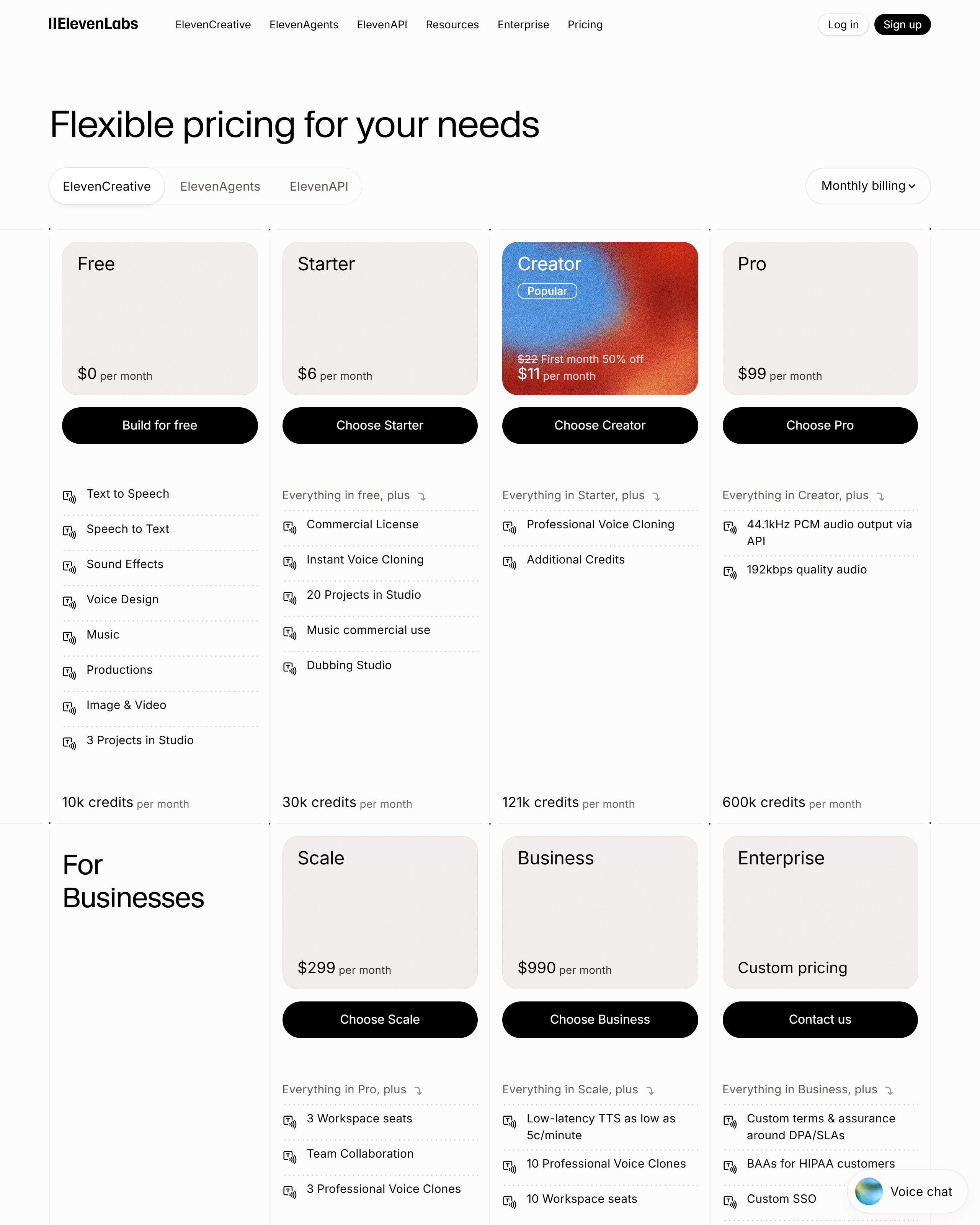
In the web app, the main pricing page says every model costs 1 credit per character. So v4, v3 and Flash all cost the same there, and the price per character comes from your plan. Creator is $22 a month for 121,000 credits: 22 ÷ 121 = about $0.18 per 1,000 characters. Starter ($6 for 30,000) works out at $0.20, and Pro ($99 for 600,000) at about $0.17.
Through the API, ElevenLabs lists prices in dollars:
| Model | API price per 1,000 characters | Characters the Creator plan ($22) includes |
|---|---|---|
| Eleven v4 | $0.08 | 275,000 |
| Eleven v3 | $0.08 | 275,000 |
| Multilingual v2 | $0.08 | 275,000 |
| Eleven v4 Turbo | $0.04 | 550,000 |
| Eleven v3 Conversational | $0.04 | 550,000 |
| Flash and the deprecated Turbo models | $0.04 | 550,000 |
The takeaway: the new models did not come with a price rise. v4 costs what v3 costs, and v4 Turbo costs what Flash costs.
Now an honest limit, because the two pages do not reconcile. The main pricing page says an API character on v4 costs 1 credit, and Creator has 121,000 credits, which would be 121,000 characters. The API pricing page says Creator includes 275,000 characters on v4 and that self-serve plans “deduct credits at a plan-specific rate”. We have not run a billed job to see which one an account follows, so watch the usage counter on your first job. The main pricing page also names “Turbo” at half a credit without saying whether that covers v4 Turbo. The only thing stated outright for v4 Turbo is its $0.04 dollar price.
Worked through two real jobs (assuming about 150 spoken words a minute, so roughly 9,000 characters in a ten-minute script):
| Job | Rough size | Web app, any model | API on v4, v3 or Multilingual v2 | API on v4 Turbo or Flash |
|---|---|---|---|---|
| A 10-minute YouTube voiceover | ~9,000 characters | ~9,000 credits | 9 × $0.08 = $0.72 | 9 × $0.04 = $0.36 |
| One audiobook chapter | ~50,000 characters | ~50,000 credits | 50 × $0.08 = $4.00 | 50 × $0.04 = $2.00 |
| What Creator ($22/mo) covers | ~13 of those voiceovers (121,000 credits) | ~30 (275,000 characters) | ~61 (550,000 characters) |
A live phone agent is metered differently. There you pay ElevenLabs’ agent rate of $0.08 a minute once your plan’s included minutes run out, with the language model and the phone line billed separately. The agents pricing page shows one minute rate and no different rate by voice model, so on a call the model choice is about speed and sound. Text messages are $0.010 each. The free plan gives you 10,000 credits and 15 agent minutes a month, and the commercial licence starts at Starter, $6 a month.
Want this in your own numbers? Put your monthly volume into our cost calculator, or check the headline rate against every platform in the price index.
Which model for which job
This is where we take a position. Quality here is our editorial judgement from ElevenLabs’ published material, with no scored listening test behind it yet.
| Your job | Use this | Why |
|---|---|---|
| Live phone agent (sales, support) | Eleven v4 Turbo | ElevenLabs’ recommended low-latency model, 90+ languages, same API price as Flash |
| YouTube, ads, dubbing | Eleven v4 | The current flagship at the price of the model it replaced |
| Audiobooks and long narration | Eleven v4, with Multilingual v2 as the fallback | The longest request size, and ElevenLabs still calls v2 its most stable on long-form |
| A language outside Multilingual v2’s 29 | Eleven v4 or v4 Turbo | 90+ languages against 70+ on v3 and 32 on Flash v2.5 |
| An agent already live on Flash v2.5 | Stay on Flash v2.5 until you have tested Turbo | Same price and the same stated latency, so there is no bill to cut by rushing |
For narration and video: v4
If the audio is recorded once and played many times, start on Eleven v4. ElevenLabs’ selection guide names v4 or Multilingual v2 for professional content, audiobooks and video narration, and v4 wins on the things you can check on paper: 90-plus languages and the longest single request in the line-up. It costs the same $0.08 per 1,000 characters as v3 through the API.
That leaves little reason to begin a new project on v3. It covers fewer languages, takes 5,000 characters at a time, costs the same, and ElevenLabs itself labels it the previous generation. If you have a v3 project that sounds right, nothing forces a move today, because no retirement date exists. Multilingual v2 keeps one honest use: ElevenLabs still describes it as the most stable model on long-form generation, so it is the fallback if v4 drifts on a long chapter in your own tests.
For a live phone agent: v4 Turbo
A phone call is unforgiving: every extra hundred milliseconds of silence reads as a stall. In June our answer here was Flash v2.5, on the grounds that it was the real-time model and it was half price. Both reasons have gone. v4 Turbo is now the model ElevenLabs’ docs recommend for low-latency work and “for the most expressive delivery” on its Agents platform, it carries the same stated median of about 100ms as Flash v2.5, and it is listed at the same $0.04.
So my lean is v4 Turbo for a new agent, and for any agent that needs a language beyond Flash v2.5’s 32. The trade-off is maturity: Turbo has been out for two months, and we have not measured it. If you already run a working agent on Flash v2.5, keep it running and test Turbo beside it before you switch. Do not put v4, v3 or Multilingual v2 on a live line. ElevenLabs publishes no latency for them and says they are designed for quality over real-time use.
The honest limits
Start with the latency numbers, because they are easy to over-read. ElevenLabs says its figures are medians of server-side latency, measured on its own production traffic over a streaming connection with a voice that has already been used. They leave out the network trip to and from your app, the wait for your language model, and audio player buffering, so what a caller hears will be slower. The figures were last updated on 29 October 2026. ElevenLabs’ own pages have not all caught up: the launch post quotes a separate “time to first speech” of about 150ms for v4 Turbo, and the model cards on the API pricing page still print about 75ms for Flash and about 280ms for v3 Conversational. We have used the documentation figures because that page is dated and explains its method.
The quality calls are ours and unmeasured. ElevenLabs’ launch post claims a first-place leaderboard ranking and a blind-test preference for v4, which is the vendor’s own account and nothing we have verified. And prices and the model list both move quickly, as this revision shows, so every figure here is dated 29 November 2026 and linked to its source.
For where ElevenLabs sits against the alternatives, see our ElevenLabs review, or put it head to head with Vapi or Retell.
Paid link, we may earn a commission. How this works.
Common questions
Which ElevenLabs model should I use for a live phone agent?
What does Eleven v4 cost?
Is Eleven v3 being retired?
What happened to Turbo v2.5?
Which ElevenLabs model is cheapest?
Sources
Every figure above is dated and links to its primary source.
- ElevenLabs models docs (read 2026-11-29): text-to-speech line-up of Eleven v4 (90+ languages, 100,000 character limit), Eleven v4 Turbo (90+ languages, median latency ~100ms), Eleven v3 and v3 Conversational (70+ languages, v3 limit 5,000 characters, Conversational ~165ms), Multilingual v2 (29 languages, 10,000 characters), Flash v2.5 (32 languages, ~100ms, 40,000 characters) and Flash v2 (English, ~135ms, 30,000 characters). v3, v3 Conversational and Multilingual v2 are described as previous generation. eleven_turbo_v2_5 and eleven_turbo_v2 sit under 'Deprecated models' with Flash replacements and no removal date. The selection guide recommends v4 or Multilingual v2 for quality and content, v4 Turbo for low latency, and v4 Turbo, Flash v2.5, Flash v2 or Multilingual v2 for agents. checked 2026-11-29
- ElevenLabs docs, how latency figures are measured (read 2026-11-29; figures last updated 29 October 2026): medians of server-side latency on production traffic over WebSocket streaming with warm voices, excluding the network round-trip, upstream steps such as the LLM, and player buffering. v4 Turbo ~100ms, Flash v2.5 ~100ms, Flash v2 ~135ms, v3 Conversational ~165ms. No latency figure is published for Eleven v4, v3 or Multilingual v2, which the page says are designed for quality rather than real-time use. checked 2026-11-29
- ElevenAPI pricing (read 2026-11-29): text to speech at $0.08 per 1,000 characters on Eleven v4, v3 and Multilingual v2, and $0.04 on v4 Turbo, v3 Conversational and Flash / Turbo. Characters included by plan, for example Creator ($22) with 275,000 on v4 or 550,000 on v4 Turbo. The FAQ says self-serve plans deduct credits at a plan-specific rate and gives a 10,000 character maximum request size for v4. The model cards on this page still print ~75ms for Flash / Turbo and ~280ms for v3 Conversational. checked 2026-11-29
- ElevenLabs pricing (read 2026-11-29): Free 10k credits, Starter $6 / 30k, Creator $22 / 121k, Pro $99 / 600k, Scale $299 / 1.8M, Business $990 / 6M per month; Commercial License first listed on Starter. FAQ: on the website every model costs 1 credit per character; through the API Eleven v4, v3 and Multilingual v2 cost 1 credit and Turbo, Flash and v3 Conversational cost 0.5; a web app generation can run to 10,000 characters on Eleven v4 and 5,000 on other models. checked 2026-11-29
- ElevenAgents pricing (read 2026-11-29): additional call minutes $0.080 on every tier, text messages $0.010 each, burst calls $0.160 a minute, included minutes 15 Free / 75 Starter / 275 Creator / 1,238 Pro / 3,738 Scale / 12,375 Business, with the language model and telephony billed separately. The page shows no different minute rate by voice model. checked 2026-11-29
- ElevenLabs launch post for Eleven v4 and v4 Turbo, published 28 September 2026 and last updated 23 November 2026: more than 90 languages, Turbo at a median inference latency of ~100ms and a median time to first speech of ~150ms, plus ElevenLabs' own ranking and blind-preference claims for v4. checked 2026-11-29